


SilneaIBD – Individual Nutritional Therapy for Crohn’s Disease
Crohn’s disease is a chronic intestinal disease that causes recurring inflammation of the gastrointestinal tract. Particularly in acute phases (flare-ups), people affected suffer from severe symptoms such as abdominal pain or diarrhea. They often lose weight and/or do not get enough nutrients.
An adapted diet can help to reduce inflammation and ensure the body receives sufficient nutrients. A special nutritional formula such as SilneaIBD is suitable for this purpose. Taking a nutritional formula can help to alleviate symptoms and prevent new flare-ups.
 Crohn’s disease is a chronic disease in which parts of the intestine become inflamed repeatedly. Crohn’s disease usually begins during adolescence or young adulthood and often affect people throughout their lives. In some cases, children may even develop Crohn´s disease before the age of ten.
The symptoms of those affected can vary greatly. These include abdominal pain, frequent diarrhea, poor appetite, weight loss, growth problems in children as well as joint and skin problems.1
 Treatment is aimed at calming the inflammation, preventing new flare-ups and providing the body with sufficient nutrients. In addition to medication, diet therefore also plays a particularly important role.1, 2
Nutritional Counseling – Individual, Professional and Covered by Health Insurance
With Crohn’s disease, appropriate nutritional therapy can alleviate symptoms, positively influence the course of the disease and prevent malnutrition. Qualified nutritional advice from a specialist is a valuable support – and is covered by health insurance in many cases.1, 2
How it works:
- Talk to your doctor about whether nutritional therapy would be beneficial for you.
- Obtain a medical certificate of necessity.
- Find a qualified nutritionist via E-Zert – Expert search, where you can locate certified specialists in your area or for an online consultation.
Important: The statutory health insurance companies usually cover the costs proportionately or even completely – if a medical certificate of necessity is available.
According to current guidelines, for mild or moderately severe disease, special nutritional therapy can be used to alleviate an acute flare-up. This nutritional therapy is called Exclusive Enteral Nutrition (EEN). People affected then consume the nutritional formula exclusively for several weeks. “Normal food”, on the other hand, should not be eaten. The aim is to stop the inflammationand to give the intestines time to recover.1

In children, this therapy has been the treatment of choice for over twenty years: 80 – 85 % of patients overcome the acute relapse (= remission) with EEN and in 75 % the intestinal mucosa is even healed. Side effects are extremely rare.1, 3
Studies have also shown that medical therapy can also be supplemented by EEN.4
How is Exclusive Enteral Nutrition Performed?
During exclusive enteral nutritional, a specialized formula such as SilneaIBD is used for 6 – 8 weeks. The formula can be consumed as a drink or fed via a tube.
In addition, drinking water, tea and possibly broth is permitted. “Normal food” is not applicable.1, 4

Tips for a successful therapy:
- Try different flavors (e.g. AroMaxx) and vary the taste of the formula
- Prepare SilneaIBD in different ways, e.g. as ice cream or warm soup
- Set small goals and reward progress
- Remove unauthorized food from the field of vision of those affected
- Participation in family meals is not mandatory
- Support the therapy together with family, friends or teachers
- as exclusive nutrition during EEN with the aim of inducing remission
- as a supplementary nutrition with the aim of maintaining the symptom-free period for as long as possible (maintenance of remission) or improving the nutritional status
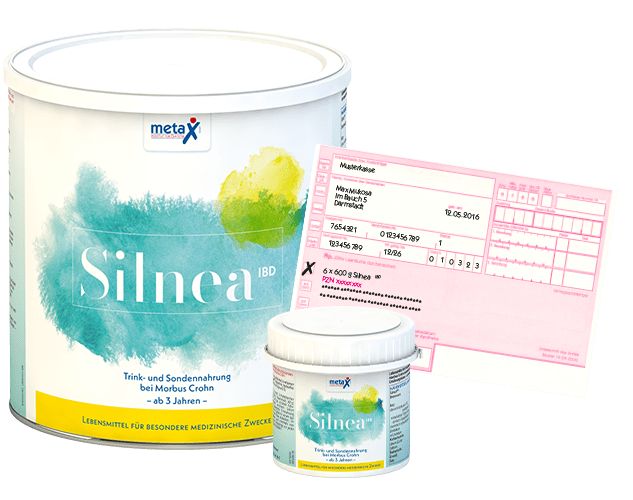
✓ very pleasant in taste
✓ easily soluble in water for oral or tube feeding – hot or cold
✓ suitable from 3 years of age
Especially for Crohn’s Disease
✓ contains vitamins, minerals and trace elements
✓ adapted to the nutritional requirements of people with Crohn’s disease and other inflammatory bowel diseases
✓ with biologically high-quality whey protein
✓ resistant starch as a microbiota-accessible carbohydrate (MAC)

To order samples and information material, click here.
 People with Crohn’s disease often suffer from malnutrition because they may eat less or because their intestine cannot absorb nutrients properly.
Malnutrition can:
- worsen the course of the disease and reduce quality of life
- lead to additional complications
- increase the frequency of diesease flare-ups
Malnourished patients are often hospitalized and suffer more frequently from serious infections.1, 2
Current guidelines recommend a healthy diet based on the recommendations of the German Nutrition Society (DGE):

- eating sufficient amounts of fruits and vegetables
- avoiding highly processed foods and convenience products
- Avoiding additives such as preservatives, emulsifiers
or sweeteners8
Exclusion diets (e.g. a diet that completely avoids foods containing wheat (gluten) or dairy products) are generally not necessary unless there is a proven intolerance.1, 2
 Yes, for children and adolescents with Crohn´s disease, nutritional therapy using products such as SilneaIBD, is considered medically necessary and may be covered by health insurance. Coverege may also be possible for adults when certain conditions are met.
With this card you can inform your attending physician about the prescription.
- Sturm A et al. (2024) (2024) Deutsche Gesellschaft für Gastroenterologie, Verdauungs- und Stoffwechselkrankheiten (DGVS). Aktualisierte S3‑Leitlinie Diagnostik und Therapie des Morbus Crohn (Version 4.1)
- Deutsche Gesellschaft für Ernährungsmedizin; Arbeitsgemeinschaft Klinische Ernährung bei chronisch-entzündlichen Darmerkrankungen (2024) S3-Leitlinie Klinische Ernährung bei CED. AWMF-Registernummer 073‑027. 2024 2024
- Bischoff et al. (2023) ESPEN practical guideline: Clinical Nutrition in inflammatory bowel disease. Clinical Nutrition
- Gordon et al. (2024) ECCO Guidelines on Therapeutics in Crohn’s Disease: Medical Treatment. J Crohns Colitis. 2024
- Montroy et al. (2020) The Effects Of Resistant Starches On Inflammatory Bowel Disease In Preclinical And Clinical Settings: A Systematic Review And Meta-Analysis. BMC Gastroenterology
- Venegas et al. (2019) Short Chain Fatty Acids (Scfas)-Mediated Gut Epithelial And Immune Regulation And Its Relevance For Inflammatory Bowel Diseases. Frontiers Of Immunology
- Plöger (2011) Die Kurzkettige Fettsäure Butyrat Stabilisiert Die Epitheliale Barrierefunktion Des Darmes
- Deutsche Gesellschaft für Ernährung e.V. (2024) DGE recommendations “Eating and drinking well”. Bonn
- Looijer-Van Langen et al. (2009) Prebiotics In Chronic Intestinal Inflammation. Inflammatory Bowel Diseases