



Simply Explained – Effects, Benefits, and Usage
Large Neutral Amino Acids (LNAAs) are a group of large neutral amino acids that occur naturally in our bodies and perform important functions. They are the building blocks of proteins and play a role in various metabolic processes. Examples of LNAAs include tryptophan, tyrosine, leucine, isoleucine, valine, and phenylalanine.1
A natural diet includes the intake of LNAAs. Even people with PKU consume them—with the exception of phenylalanine—through their amino acid mixture. In LNAA therapy, these amino acids are administered in higher amounts.2
In people with PKU, the enzyme phenylalanine hydroxylase (PAH) does not function properly. As a result, the amino acid phenylalanine can not be broken down properly, causing it to accumulate in the blood. Some of the excess phenylalanine from the blood then enters the brain, where it can cause significant damage.1
To enter the brain, phenylalanine uses a specific transporter (LAT1) in the blood-brain barrier. The LNAAs also use this transport pathway. If a large amount of LNAAs is ingested, they compete with phenylalanine for the same transport. As a result, less phenylalanine enters the brain, while at the same time more of the other amino acids can be absorbed.1
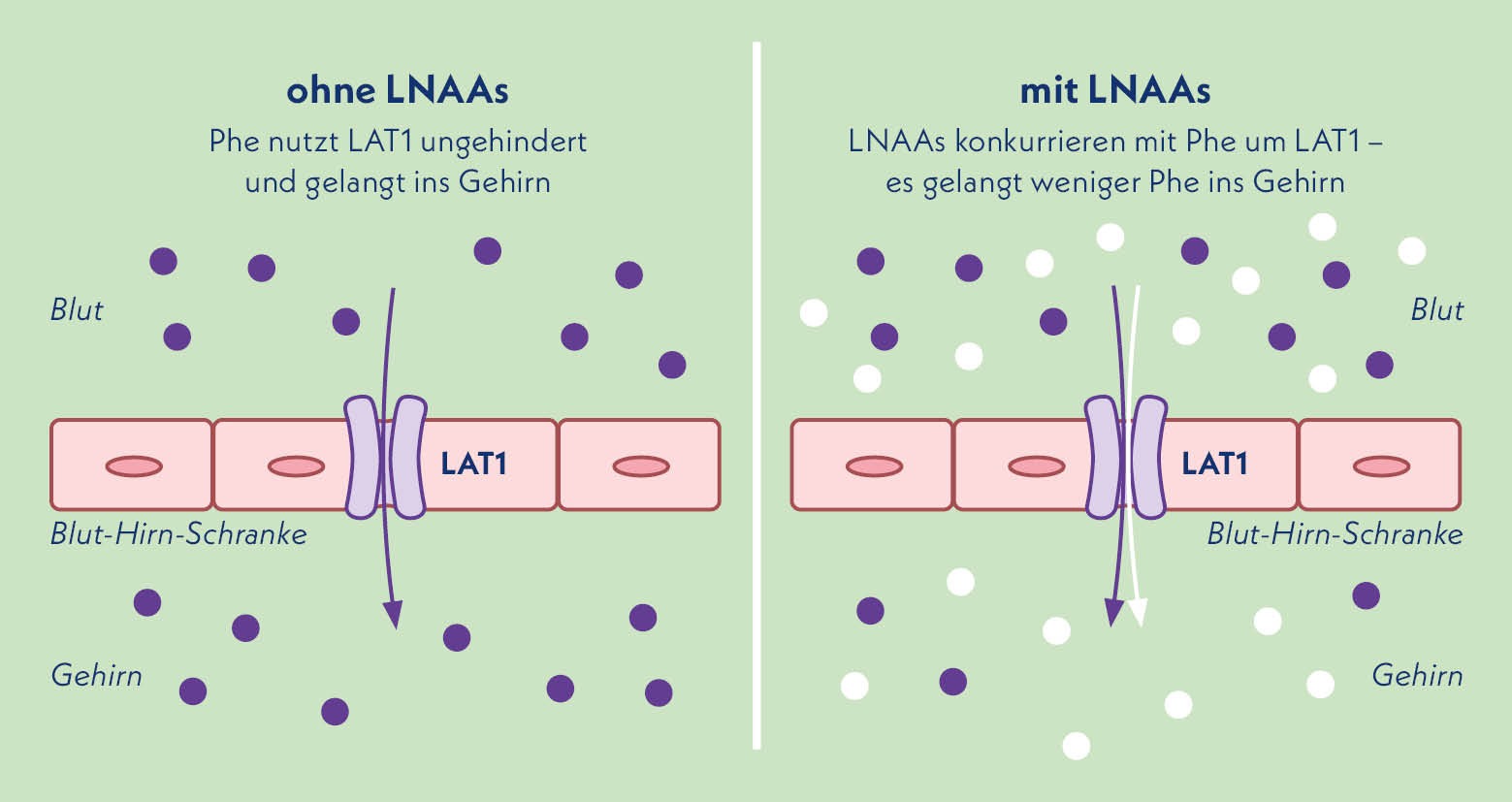
You can think of the transporter as a door through which only a few people can pass at a time. Both phenylalanine and the other large neutral amino acids are waiting in front of this door. They all want to get through. When there are many LNAAs in front of the door, they occupy the passageway more frequently. This makes it harder for phenylalanine to get through the door.
The goal of LNAA therapy is not to lower the level of phenylalanine in the blood. Instead, LNAAs primarily act where they compete with phenylalanine for transport into the brain – at the “gateway” to the brain. As a result, fewer phenylalanine molecules can enter the brain despite unchanged high blood levels.1 Since lower phenylalanine levels in the brain are not easily detectable, it is difficult to verify the success of this therapy.
Because treatment success is difficult to measure, the current European PKU guidelines do not recommend the routine use of LNAAs.3
LNAAs are suitable for:
- Adults with PKU who find it difficult to adhere to the traditional low-phenylalanine diet over the long term.
- Adults with PKU for whom other treatment options are not an option or who do not respond to them.
- Adults with PKU that was treated late or inadequately, for whom protecting the brain is a particular priority.
Important: LNAAs may be an alternative to the traditional PKU diet for these adult patients. The decision on whether treatment is appropriate should always be made in consultation with the treating metabolic center and the patient.
LNAA therapy is not recommended for children and adolescent due to insufficient data. It´s not allowed to use it during pregnancy.3
 Taking LNAAs can be an alternative to traditional dietary management involving amino acid mixtures and a low-protein diet. They help ensure the body receives essential amino acids and inhibit the uptake of phenylalanine into the brain.1
Possible benefits of LNAA therapy may include:
→ Support for brain function: LNAAs provide important amino acids that are needed, among other things, for the production of neurotransmitters in the brain.
→ Improved concentration and attention: Some people with PKU report a positive change, but the effect varies from person to person.
→ Dietary Supplement: LNAAs can help provide certain amino acids that are consumed in smaller amounts on a low-phenylalanine diet.
→ More freedom: Depending on the individual treatment plan, taking LNAAs may allow for a less restrictive low-phenylalanine diet. Whether and to what extent the diet can be adjusted should be determined in consultation with the treating metabolic center.4
- LNAAs are large neutral amino acids.
- LNAAs act primarily at the blood-brain barrier: They compete with phenylalanine for transport into the brain and can thereby reduce the uptake of phenylalanine into the brain.
- LNAAs do not lower blood phenylalanine levels.
- LNAAs may serve as an alternative to the traditional PKU diet.
- Whether LNAA therapy is an option is determined on a case-by-case basis with the metabolic center.
- LNAA therapy is not recommended for children and must not be used during pregnancy.
- The effects of LNAAs vary: Some people benefit more than others.
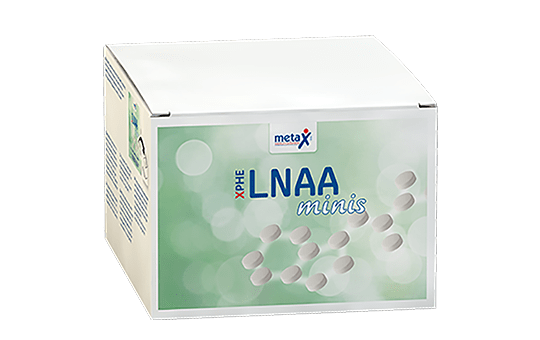 XPhe LNAA minis are a food for special medical purposes (balanced diet) intended for dietary management of phenylketonuria (PKU) or hyperphenylalaninemia (HPA). They are enriched with a high content of large neutral amino acids (LNAAs).
Thanks to their tablet form, XPhe LNAA minis can be easily incorporated into daily life.
For more information on the use and dosage of XPhe LNAA minis, please see here.
- Pietz et al. (1999) Large neutral amino acids block phenylalanine transport into brain tissue in patients with phenylketonuria
- van Spronsen et al. (2010) Large neutral amino acids in the treatment of PKU: from theory to practice
- van Wegberg et al. (2025) European guidelines on the diagnosis and treatment of phenylketonuria: First revision
- Ahring (2009) Large neutral amino acids in daily practice